

Postproxy covered all the major platforms I needed. I am very glad I switched.
miingl social gives businesses one place to plan, generate, approve, schedule, and publish social content. Postproxy handles the account connections, publishing, and post analytics underneath.

Co-founder and COO, miingl
Supporting a full set of social networks means a separate authentication flow, media requirements, publishing formats, error responses, and API change cycle for each one — engineering time miingl needed for its own product instead.
Use Postproxy as the publishing layer. miingl sends approved content through one API and keeps ownership of brand context, generation, approvals, and scheduling. Postproxy handles platform-specific execution, and the stats that come back feed Brand DNA and generation.
miingl social starts with the business behind the content.
Customers add their website, documents, goals, events, audience details, and brand preferences. miingl turns that context into a persistent Brand DNA used to create copy, images, videos, and platform-specific posts.
The team can then review the output, request changes, approve it, and decide when it should go live. Each project can run manually, automatically, or somewhere in between.
Each social network has its own authentication flow, media requirements, publishing formats, error responses, and API changes.
Building those connections directly would consume engineering time that miingl needed for its own product: Brand DNA, content generation, approval workflows, scheduling, audience intelligence, and customer controls.
miingl uses Postproxy as its publishing layer. The product sends approved content through one API, while Postproxy handles the platform-specific execution underneath — validation, delivery states, retries, and the failure cases that otherwise land on the product team.
Postproxy covered all the major platforms I needed. I am very glad I switched.
miingl controls everything its customers interact with:
Once a post is ready, Postproxy handles the connection to the selected social accounts and publishes it through the relevant official APIs. miingl sees delivery progress through Postproxy rather than wiring each network's status model into the product.
That separation lets miingl keep improving its content system without rebuilding the publishing infrastructure each time it adds a workflow, customer type, or platform.
Publishing is not a one-way handoff.
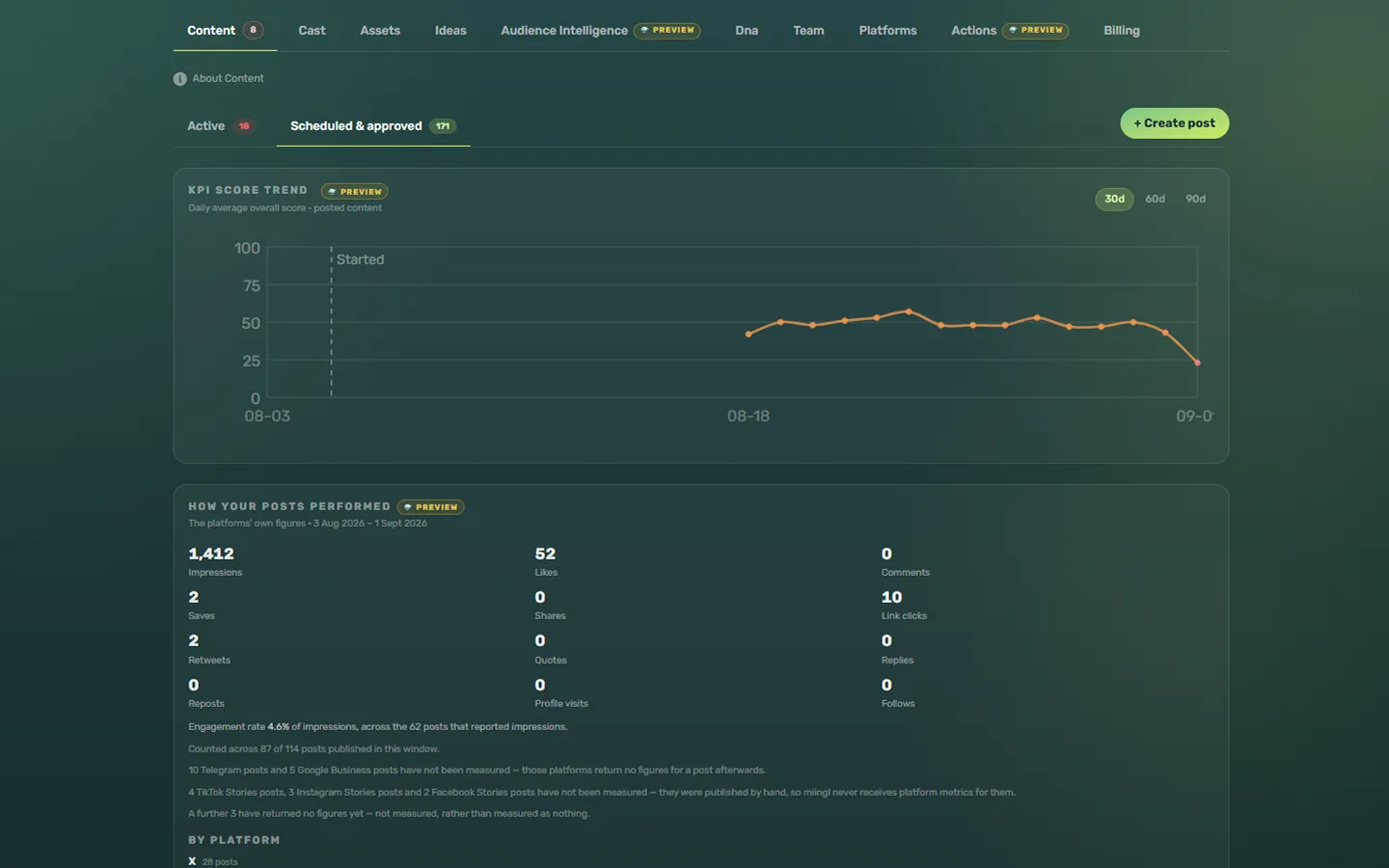
miingl pulls post stats through Postproxy and uses them to train its AI, improve Brand DNA, and refine generation for the next round of content.
Postproxy also sits behind audience intelligence, which miingl is about to release. It will pull comments from published posts, surface the ones that need a reply first, and cluster similar comments so they can become new content ideas and more training signal for the system.
miingl keeps content generation and live publishing under separate release controls.
The team can run generation in live, simulated, or paused modes. Publishing can be connected to real social accounts or routed through a stub while the rest of the workflow is tested.
This makes it possible to develop generation, approval, and scheduling features without turning every test into an unfortunate public announcement.
When the workflow is ready, real publishing can be enabled independently.
Each miingl project brings its content operation into one workspace.
Content is grouped by state, so editors can see what is active, what still needs work, and what is already scheduled and approved.
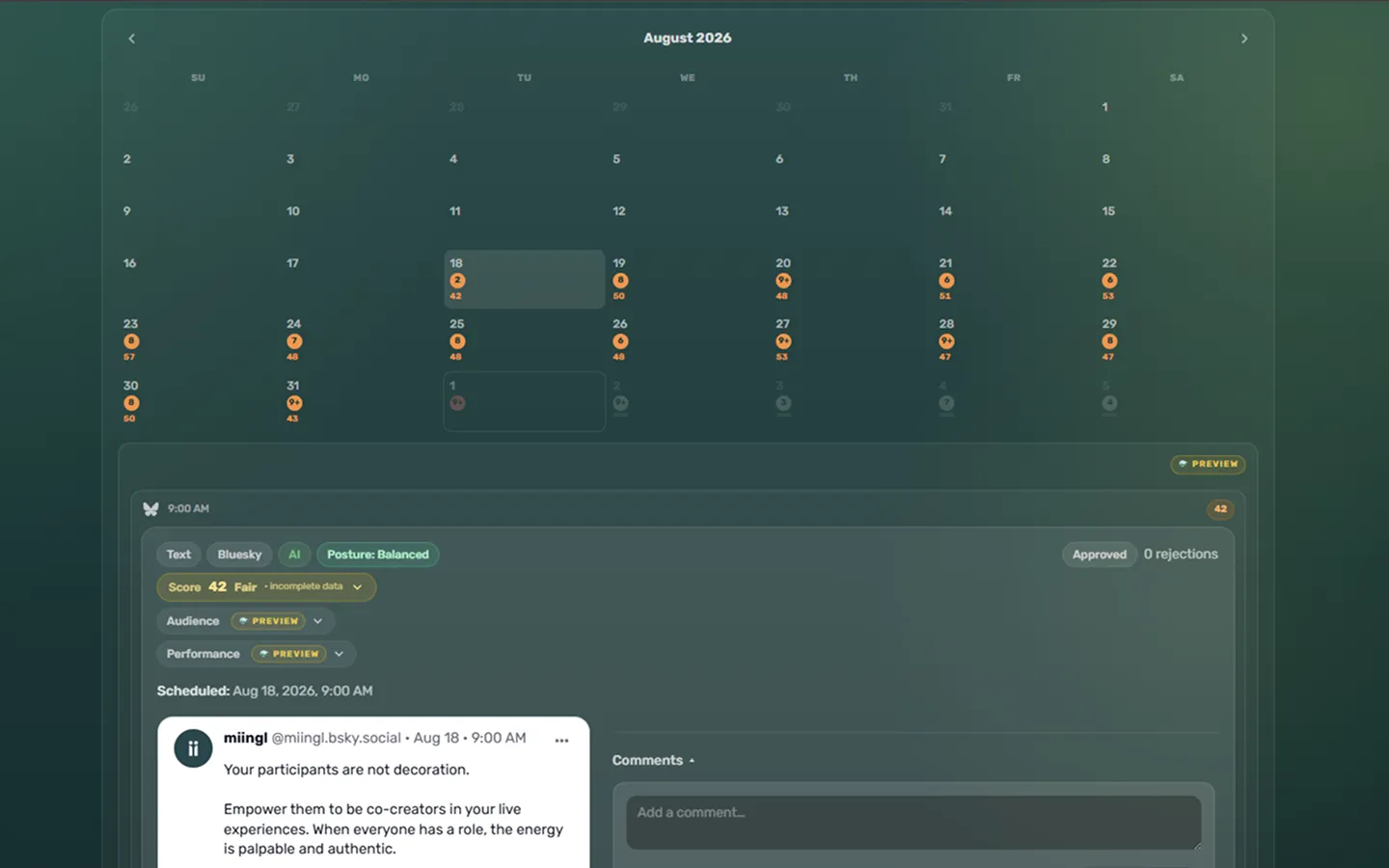
The calendar is that schedule in one view. Each day shows what goes out, and opening a post shows the platform, the score, and whether it has been approved.
Postproxy sits at the final stage of that workflow and makes sure approved content reaches the connected platforms.
Jake previously used Ayrshare while building miingl. Switching was about covering the networks the product needed without making the publishing layer one of the most expensive parts of the stack.
Postproxy fit that trade-off: broad enough platform coverage for an AI-native social product, without delivery becoming a major cost or maintenance burden.
With Postproxy, miingl can provide:
Postproxy makes that setup practical:
Connect customer accounts and publish across major social platforms without maintaining every integration yourself.